
Reducing risk when working at height on high voltage transformers
Background
In 2017, our Coyle Group consultant observed a safety risk at our customer, related to high voltage (HV) transformers whilst undertaking a site visit for a separate piece of work. Network Technicians were working on HV transformers without having the required control measures and were consequently exposed to a risk of falling from a height. Our consultant raised this risk with the local and senior managers at our customer.
Legal Compliance
Not only was this an unsafe practice, putting employees and contractors at risk, but additionally the ‘Safety, Health and Welfare at Work (General Applications) Regulations 2007, Part 4 – Work at Heights’ was at risk of being breached.
Further Investigation
This prompted a closer look at working practices, which showed that a safe system of work on older HV transformers was not in place. The older high voltage transformers did not have a manufactured designed proprietary guard rail system or fall arrest anchorage system attached.
Establishing A Working Group
A high voltage station working group was then established. Our Coyle Group safety consultant was invited to join the group. The working group’s role was to develop solutions to mitigate or eliminate the falls from a height risk that had been identified with the older high voltage transformers. The Coyle Group consultant played a critical role in the group, acting as the health and safety specialist, providing risk assessments, legislation expertise and safety insight from other sectors and industries.
Finding The Right Solution
Over the next year, the working group trialed a few possible solutions to mitigate the risk. It was not an easy risk to address as there was no available solution specifically designed for these older transformers.
Additionally, constraints around the way these transformers work and have been designed, made it even more difficult. For example, because these transformers only have limited outage durations (1-2 days) it may not be practical to erect scaffolding around the whole perimeter of the transformer. Also, access to these transformers can be difficult, making other sorts of scaffolding impractical and anchor points for safety systems away from leading edges can be limited.
A lifeline anchor system, a type of fall arrest temporary horizontal lifeline system, that works by anchoring to existing lifting eyes on HV transformers, was eventually found to be the best solution.
Coyle Group was at our customer’s side throughout the development of the solution, attending site visits and trials across Ireland, assessing whether the proposed solution would sufficiently improve the safety of the sites and reduce exposure to breach of legislation.
Horizontal Lifeline System
A temporary horizontal lifeline system allows an individual to attach his/her retractable lanyard to a fall arrest lifeline. This ensures that the user is fully secured to the system at all times. Once secure, the user can move freely to perform work tasks while being totally secured to a fall arrest system.
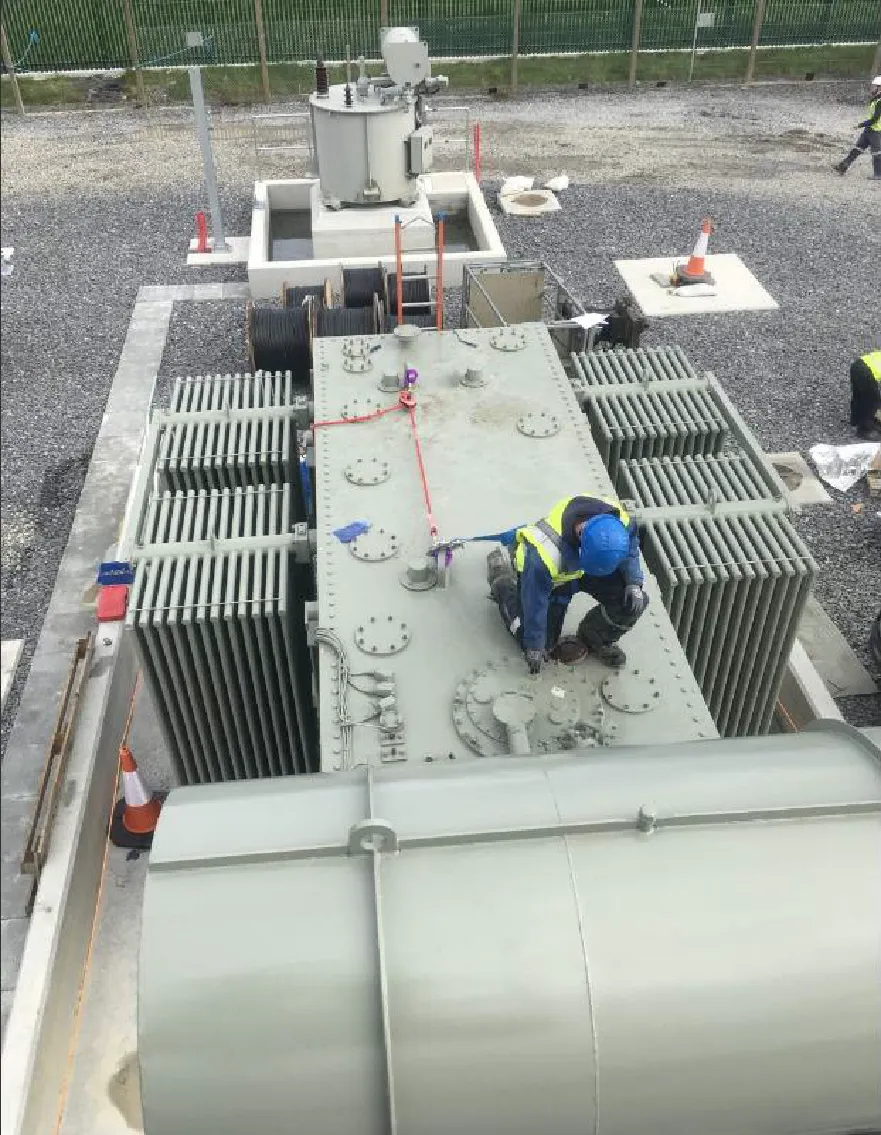
Example of a horizontal lifeline system
During trials, the working group identified an additional safety requirement – the need for a rescue plan in the event of a fall and suspension in a harness. So, once a fall arrest system was selected, a rescue plan was developed and put in place by the working group.
With a new fall arrest system and rescue plan in place, it was clear that the business also needed a clear and documented national working procedure so that network technicians work in a consistently safe and controlled manner whilst aloft on an HV transformer. The working group established a national procedure, which was reviewed and approved by the customer’s Senior Manager and implemented nationwide. Our consultant was a key contributor to this procedure, developing content within it, answering management questions and being part of the final presentation team to senior managers.
A Safer National Working Practice
Over the course of this work, Coyle Group played a pivotal role in our customer’s working group to plan, implement and assure the following:
- temporary horizontal lifeline systems nationwide
- a rescue plan
- a new procedure for installation and use of the system
These actions reduce the risk of falling from a height and thus significantly improve the safety of Network Technicians working on high voltage transformers. It gives staff and contractors the confidence that their employer is protecting their safety.
Our customer can now clearly demonstrate that they have put measures in place for their technicians to work safely and securely as per the General Application Regulations 2007.
Improve the compliance of your business today
Talk with Gavin who can help you on your safety journey
RIDDOR and COVID-19
Many employers are concerned about their reporting obligations for COVID-19/Coronavirus/SARS-CoV-2 under RIDDOR in the ongoing pandemic. You may be pleased to know that you do not have to report everything to the Health and Safety Executive (HSE). We'll provide more info about when, what, and how to report.
The most common concern we've seen recently from employers is whether they need to report all COVID-19 and coronavirus testing results to the HSE. The short answer is no. According to the HSE: “There is no requirement under RIDDOR (The Reporting of Injuries, Diseases and Dangerous Occurrences Regulations 2013) to report incidents of disease or deaths of members of the public, patients, care home residents or service users from COVID-19. The reporting requirements relating to cases of, or deaths from, COVID-19 under RIDDOR apply only to occupational exposure, that is, as a result of a person's work.”
Generally speaking, the ordinary RIDDOR rules already cover COVID-19. You should only make a report under RIDDOR when one of the following circumstances applies:
• an accident or incident at work has or could have caused the release of coronavirus (SARS-CoV-2). (Report as Dangerous occurrence)
• a worker is diagnosed with COVID-19 due to occupational exposure. (Report as Disease)
• a worker dies because of occupational coronavirus exposure. (Report as Work-related death due to exposure to a biological agent)
The bottom line is that existing rules cover most COVID-19 measures, and most of the COVID-19 guidance comes from public health authorities rather than the HSE. The environment remains chaotic, but you can minimize your legal exposure by continuing your existing compliance steps. This will include communicating with your insurer about risks, following public health guidance, and communicating regularly with your workers or unions on any of their concerns.




© Gavin Coyle, 2021